A Household Energy Audit Checklist for Filipino Families
With rising electricity prices and unpredictable bills, more and more Filipino households are asking:
“Saan napupunta ang kuryente namin?”
The truth is, much of the power we pay for is wasted — through inefficient appliances, poor usage habits, and “phantom loads” that quietly drain power 24/7. But the good news? You can take control.
This simple Household Energy Audit Checklist will help you identify hidden energy drains in your home — and unlock savings of up to ₱1,000 to ₱3,000 per month for an average household.
What Is a Household Energy Audit?
An energy audit is a systematic check of how, where, and when your household uses electricity. It helps you answer:
It’s like a financial audit, but for your electric bill.
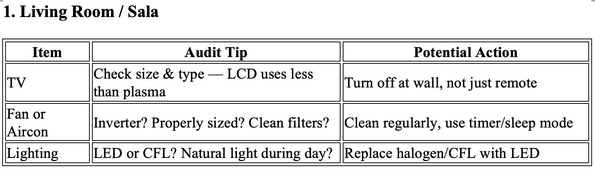
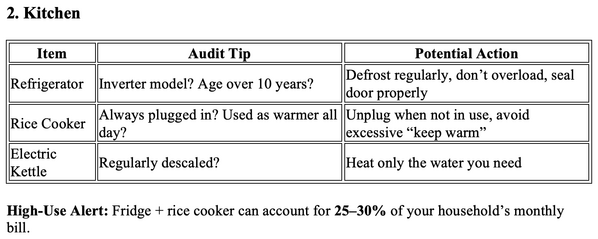
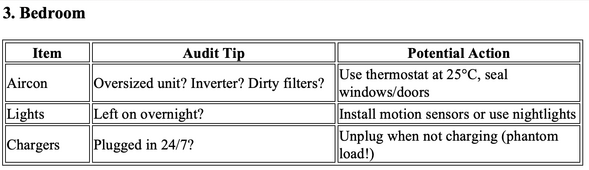
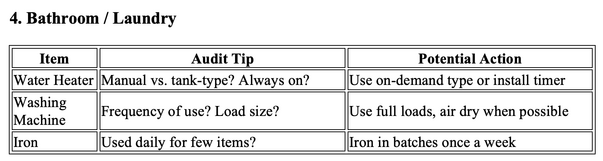
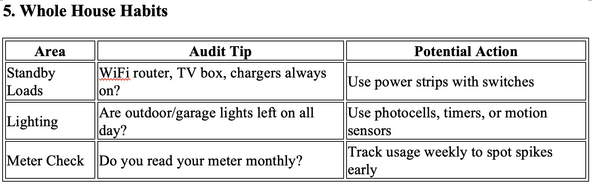
The Household Energy Audit Checklist
Use this checklist room-by-room. At the end, we’ll show you how to calculate your savings potential.
With rising electricity prices and unpredictable bills, more and more Filipino households are asking:
“Saan napupunta ang kuryente namin?”
The truth is, much of the power we pay for is wasted — through inefficient appliances, poor usage habits, and “phantom loads” that quietly drain power 24/7. But the good news? You can take control.
This simple Household Energy Audit Checklist will help you identify hidden energy drains in your home — and unlock savings of up to ₱1,000 to ₱3,000 per month for an average household.
What Is a Household Energy Audit?
An energy audit is a systematic check of how, where, and when your household uses electricity. It helps you answer:
- Which appliances use the most energy?
- Are there leaks, waste, or inefficiencies?
- What habits cost you the most — and how can you fix them?
It’s like a financial audit, but for your electric bill.
The Household Energy Audit Checklist
Use this checklist room-by-room. At the end, we’ll show you how to calculate your savings potential.
What’s Driving Your Bill?
Most Filipino households see energy use concentrated in a few key areas:
Small Fixes, Big Impact
Here are some easy wins that can shave hundreds — even thousands — of pesos off your bill every month.
Lighting
Cooling (Aircon + Electric Fans)
Refrigerator
Rice Cooker, Kettle, and Small Appliances
Phantom Loads (Standby Power)
Many devices continue to draw power even when not in use — including:
Laundry and Ironing
Easily, your household can enjoy
Total Monthly Savings: ₱1,000 to ₱2,500+
Annual Savings: ₱12,000 to ₱30,000+
And that’s without replacing any appliances yet. If you upgrade to inverter aircon, fridge, and washing machine, long-term savings can go even higher — especially with appliance lifespans of 10–15 years.
Quick Checklist
So here's a quick checklist to ask yourself:
Audit First, Upgrade Second
Before buying expensive solar panels or new appliances, start with a home energy audit. You’ll gain:
Most Filipino households see energy use concentrated in a few key areas:
- Air conditioning and cooling: 30–50% of household usage
- Refrigeration and kitchen appliances: 20–30%
- Lighting and electronics: 10–15%
- Standby or “phantom” loads: 5–10% (yes, even when devices are off!)
Small Fixes, Big Impact
Here are some easy wins that can shave hundreds — even thousands — of pesos off your bill every month.
Lighting
- Replace all CFL or incandescent bulbs with LED
- Use natural daylight whenever possible
- Turn off lights in unoccupied rooms
Cooling (Aircon + Electric Fans)
- Set AC to 24–26°C — each degree lower adds ~6–8% to your bill
- Use inverter-type models if possible
- Clean filters monthly for better airflow
- Use fans instead of aircon when you can
Refrigerator
- Don’t overload the fridge — it blocks airflow and wastes energy
- Keep door seals tight to prevent cool air leaks
- Defrost regularly (for non-auto defrost models)
- Replace older, non-inverter units if budget allows
Rice Cooker, Kettle, and Small Appliances
- Don’t keep rice cooker on “warm” for hours
- Heat only the water you need in electric kettles
- Batch cooking saves both time and energy
Phantom Loads (Standby Power)
Many devices continue to draw power even when not in use — including:
- Wi-Fi routers
- TV boxes and gaming consoles
- Chargers left plugged in
- Microwave displays and clocks
- Use a power strip with a master switch
- Unplug devices when not in use
Laundry and Ironing
- Run the washing machine on full loads
- Air-dry clothes instead of using a dryer
- Batch iron once or twice a week
Easily, your household can enjoy
Total Monthly Savings: ₱1,000 to ₱2,500+
Annual Savings: ₱12,000 to ₱30,000+
And that’s without replacing any appliances yet. If you upgrade to inverter aircon, fridge, and washing machine, long-term savings can go even higher — especially with appliance lifespans of 10–15 years.
Quick Checklist
So here's a quick checklist to ask yourself:
- Have I switched to all-LED lighting?
- Is my aircon set above 24°C and cleaned regularly?
- Are my fridge and rice cooker energy-efficient models?
- Do I unplug chargers and appliances not in use?
- Am I running full laundry loads and batch ironing?
Audit First, Upgrade Second
Before buying expensive solar panels or new appliances, start with a home energy audit. You’ll gain:
- Immediate savings
- Better control over your bills
- A clearer idea of which upgrades make the most sense
 RSS Feed