• Home
  • About Us
  • Project Briefs
  • Collaborations
    • Challenergy, Inc.
    • Cool Innovation Inc.
    • Supercondenser Tech Corporation
  • Contact Us
  • BLOG: Infrastructure for Tomorrow
  CETI Philippines
For inquiries:

Decentralized vs. Centralized Power Systems: What’s Best for the Philippines?

7/29/2025

0 Comments

 
As the world transitions to more sustainable, resilient, and inclusive energy systems, a key debate has emerged: Should countries continue relying on centralized power grids, or shift toward decentralized, distributed energy models?

This isn't a purely technical question. It’s about energy justice, resilience, climate adaptation, and strategic control. For the Philippines, with its archipelagic geography, frequent climate shocks, and rising electricity demand, the answer could define its energy future.

Let’s unpack the centralized vs. decentralized power systems debate — and where each approach fits in a modern energy strategy.

What Is a Centralized Power System?


In a centralized system, electricity is generated at large-scale power plants (e.g., coal, gas, hydro, nuclear) and transmitted through a national grid to consumers. This model has been dominant for over a century.
PROS
  • Economies of scale in generation
  • Established infrastructure and technical standards
  • Centralized planning and control
CONS
  • Long transmission distances = high losses (~7–15% in some cases)
  • Vulnerable to grid failure, typhoons, or terrorism
  • High capital intensity and long lead times
  • Difficult to reach off-grid or remote areas
  • Rigid — not optimized for integrating variable renewables

What Is a Decentralized Power System?

In a decentralized system, electricity is generated closer to where it is used — at the household, community, or industrial level — through systems like:
  • Rooftop solar PV
  • Battery storage
  • Microgrids or mini-grids
  • Biomass or biogas plants
  • Diesel-solar hybrid systems
These can operate on-grid, off-grid, or in hybrid modes.
PROS
  • Greater energy access in remote areas
  • Faster deployment and lower barriers to entry
  • Reduces transmission losses
  • Builds resilience in disaster-prone regions
  • Empowers consumers (prosumers, community cooperatives)
CONS
  • Complex coordination if scaled without planning
  • May lack stability without smart grid tech or backup
  • Higher unit costs if not aggregated
  • Regulatory and financing barriers still present

Global Trends: Moving Toward Hybrid Systems

Even in countries with strong centralized systems, decentralization is rising:
  • Germany: Over 50% of renewable generation comes from citizen-owned or community-based systems.
  • India: Microgrids and solar home systems are rapidly expanding in rural states.
  • California: Facing wildfire-induced outages, it’s investing in community resilience hubs and battery-backed solar systems.
The trend is clear: hybridized power systems — where centralized grids coexist with decentralized assets — offer the best of both worlds.

What About the Philippines?

As an archipelago with 7,000+ islands, 25% rural energy poverty, and a grid prone to natural disasters, the Philippines is a textbook case for decentralized energy.
Challenges with Centralization:
  • Long transmission lines across seas
  • Grid congestion in Luzon and Visayas
  • Single points of failure during typhoons and earthquakes
  • Delays in expanding the main grid to Mindanao and off-grid islands
Opportunities in Decentralization:
  • Solar PV + battery systems in barangays and islands
  • Waste-to-energy microgrids in urban areas
  • Hydrogen-ready mini-grids for remote industries
  • Community-owned RE cooperatives, enabled by R.A. 9136 and R.A. 9513
The DOE’s Microgrid Systems Act (R.A. 11646) and Net Metering under EPIRA already provide legal frameworks — but implementation, capacity-building, and financing remain bottlenecks.

🧭 The Smart Path Forward: Integrated, Modular PlanningThe Philippines need not pick one model over the other. Instead, it should:

  1. Strengthen the main grid where feasible and cost-effective.
  2. Accelerate decentralized systems in remote, disaster-prone, and underserved areas.
  3. Embed smart controls and grid interconnection standards to enable bi-directional power flow.
  4. Provide blended finance (grants + soft loans) for decentralized systems through Green Energy Option Program (GEOP), JCM, or climate finance.
  5. Treat decentralization as strategic resilience infrastructure, not just rural electrification.

Final ThoughtsThe energy transition isn't about replacing one centralized system with another. It's about building smarter, more resilient systems that reflect local contexts, equity, and sustainability.
For the Philippines, the case is clear: Empower the edge. Light up islands, farms, barangays, and schools with clean, distributed power. Make the energy system modular, adaptive, and people-centric.
The future isn’t one grid — it’s many nodes, one goal: reliable, clean energy for all.
#DecentralizedEnergyPH #MicrogridRevolution #ResilientEnergy #EnergyAccess #HybridPowerSystems #CleanEnergyTransition #RuralElectrification #SmartGridPH
0 Comments

Energy Efficiency First: The Smartest Step Before Renewables

7/29/2025

0 Comments

 
In the race toward a clean energy future, renewable energy often takes center stage — solar panels gleaming on rooftops, wind turbines spinning along coastlines. But what if the most powerful climate solution isn't a new energy source, but using less energy to begin with?

This is the logic behind the global principle of “Energy Efficiency First” — a concept embraced by the European Union, the International Energy Agency (IEA), and climate-savvy nations around the world.

Put simply: Before we build new energy supply, we must optimize how we use what we already have.

What Is “Energy Efficiency First”?“

Energy Efficiency First” (EEF) means that every decision on energy planning, infrastructure, and investment must consider energy savings before supply-side expansion — whether from fossil fuels or renewables. It’s not about delaying solar and wind. It’s about right-sizing them — based on lower, more rational energy demand.

Think of it this way:  Before buying a bigger generator, fix the leaks and switch off the waste.

 Why Efficiency First?

The Numbers Speak 
  • An average household wastes 20–30% of its electricity through inefficient appliances and poor insulation.
  • Commercial buildings in Southeast Asia often exceed 250 kWh/m²/year, double what’s achievable through retrofits.
  • Industrial motors and compressed air systems can waste up to 50% of input energy without optimization.
In the Philippines, where electricity is among the most expensive in Asia, reducing energy demand through efficiency translates into:
✅ Lower power bills
✅ Lower system losses
✅ Less generation needed (renewable or otherwise)
✅ Deferred or avoided grid investments
✅ Reduced fossil backup needs

The Renewable Energy Trap: Oversizing Without Efficiency

Without energy efficiency, new renewable capacity risks being overbuilt or poorly utilized:
  • A household that hasn’t replaced its 15-year-old refrigerator or installed LED lighting will need a larger solar PV system than necessary.
  • A commercial building with poor HVAC controls may claim “100% solar-powered” — but it's using twice the energy it could with better design.
This leads to higher capital costs, greater land use, and slower ROI on renewable investments.

International Best Practices
  • European Union: Energy Efficiency First is embedded in energy planning under the EU Energy Union strategy.
  • U.S. Department of Energy: Recognizes efficiency as the “first fuel” — the cheapest and cleanest energy resource.
  • Japan’s Top Runner Program: Raised appliance standards so high that energy demand has been flat despite economic growth.

What the Philippines Must Do

In the Philippine context, applying “Energy Efficiency First” is not just smart — it’s essential:
  1. Implement RA 11285 (Energy Efficiency and Conservation Act) fully, with strong compliance mechanisms for LGUs, government buildings, and designated establishments.
  2. Integrate EEF in the Green Building Code, and require building energy performance disclosures.
  3. Link solar incentives to building efficiency — e.g., require minimum building performance before PV installation is subsidized.
  4. Support demand-side management in the grid, reducing peak loads through efficient lighting, AC, and industrial controls.
  5. Upgrade public infrastructure — schools, hospitals, and government offices — with efficient systems before or alongside installing renewable energy.

Efficiency First Is Not Anti-Renewable — It’s Pro-Logic

No one’s arguing against solar or wind. But imagine this:
A solar-powered building that wastes half its energy is not green — it’s just solar-powered waste.
Energy efficiency multiplies the benefits of renewables:
  • Smaller systems, lower capital
  • Faster payback periods
  • Greater resilience during outages
  • Lower emissions per peso spent

Conclusion: Do More With Less

“Energy Efficiency First” is not just a policy idea — it’s a mindset. Before we rush to build new energy systems, we must stop wasting what we already generate. Only then can renewables do what they’re meant to: replace fossil fuels, not compensate for our inefficiencies.
​
In an archipelagic country facing grid constraints, volatile energy prices, and climate risks, efficiency is our first line of defense and fastest win.

Let’s get the basics right — then power the future.

#EnergyEfficiencyFirst #GreenPhilippines #ClimateActionNow #RA11285 #SmartEnergy #LowCarbonTransition #SustainableBuildings
0 Comments

Energy Efficiency in Schools, Hospitals, and Government Buildings

7/28/2025

0 Comments

 
Why Public Funds Shouldn’t Pay for Energy Waste

When we talk about energy efficiency, we often think of households, malls, or factories. But one of the most urgent and overlooked areas is the public sector: schools, hospitals, LGU buildings, government offices — all powered by taxpayer-funded electricity.

Here’s the uncomfortable truth:

Every kilowatt-hour wasted in a government facility is paid for by the Filipino people.

Whether it's a hospital running outdated air conditioners, or a city hall with lights on 24/7 — that’s public money burned. In a country facing energy insecurity, tight budgets, and climate risk, we can’t afford inefficiency in our most essential services.

What’s the Scale of the Problem?

The Philippine government is the single largest consumer of electricity in the country — spanning over 30,000 public schools, 700 public hospitals, and thousands of city halls, barangay centers, and regional offices.
And yet:
  • Many public buildings still use inefficient lighting, air conditioners, and chillers
  • There’s no real-time energy monitoring in most facilities
  • Energy performance data is rarely reported — if at all
  • Maintenance is reactive, not efficiency-oriented
The result? Wasted power, inflated bills, and missed opportunities to redirect savings to salaries, medicine, classrooms, and community services.

Why It Matters in Hospitals, Schools, and LGUs

In Schools
  • Lights, fans, and equipment are often left running unnecessarily
  • Classrooms use non-inverter aircon, with no zoning or schedule control
  • Budgets meant for learning materials are diverted to pay electricity
Impact: Wasted electricity literally takes away from education.

In Hospitals
  • Many government hospitals run 24/7 lighting and cooling without energy zoning
  • Critical equipment is often placed in rooms with poor thermal insulation
  • Old HVAC systems operate inefficiently and without scheduled maintenance
Impact: Resources that could be used for medicine, staff, or new beds are spent on high utility bills.

In Government Buildings
  • Window aircons and box-type units run all day in poorly sealed offices
  • Elevators, lighting, and water pumps operate without load control
  • Government pays for phantom loads — computers, printers, routers left on overnight
Impact: Taxes go to wasted power, not public service delivery.

What Are We Losing?The Department of Energy (DOE) estimates that the public sector could save:
  • ₱2 to ₱5 billion annually just by implementing basic EE retrofits
  • 15–25% reductions in electricity use with lighting, HVAC, and equipment upgrades
  • Huge reductions in GHG emissions — without building new power plants
Let’s be clear: Every watt saved is a peso redirected to people.

What Can Be Done?

Here’s a no-excuses roadmap:
1. Implement RA 11285 (EE&C Act) in the Public Sector
  • Appoint Energy Efficiency and Conservation Officers (EECOS) in each public agency
  • Require annual energy audits and disclosure of energy use
  • Mandate Energy Efficiency Performance Standards (EEPS) for government buildings

2. Retrofit High-Use Public Buildings First
Prioritize retrofitting:
  • Public hospitals (especially with 24/7 operations)
  • Large schools and university campuses
  • LGU and national government buildings over 1,000 sqm
Common retrofits include:
  • LED lighting + daylighting systems
  • Inverter HVAC systems with zoning controls
  • Smart meters and energy dashboards
  • Solar PV with battery for critical loads

3. Use Performance-Based Energy Service Contracts (ESCOs)
  • Let third-party providers retrofit facilities at no upfront cost, paid back through energy savings
  • Structure shared savings contracts to ensure government only pays when savings are real
  • DOE has a ready National ESCO Accreditation System — use it.

4. Make EE a Governance Indicator
  • Include energy use per square meter in LGU performance reports
  • Require energy use disclosures in the Seal of Good Local Governance (SGLG) criteria
  • Give public recognition or budget bonuses for most efficient LGUs or agencies

Why This Is a Governance Issue

Energy efficiency in public buildings is not just a technical issue — it's a moral one.
  • Why are we spending public funds on outdated, wasteful systems?
  • Why are we burdening teachers and nurses with poor lighting or hot rooms?
  • Why are we building new power plants when we haven’t fixed demand-side waste?
A government that is serious about climate action, fiscal responsibility, and service delivery must start by fixing its own house.

Bottom Line

Energy efficiency in schools, hospitals, and government offices isn’t about gadgets or green branding — it’s about public accountability.
Every watt saved is:
  • A classroom repaired
  • A hospital bed upgraded
  • A barangay served better
In a nation where budgets are tight, electricity is expensive, and climate impacts are rising, wasting energy is no longer just costly — it’s unjust.
0 Comments

How Much Can You Save?

7/28/2025

0 Comments

 
A Household Energy Audit Checklist for Filipino Families

With rising electricity prices and unpredictable bills, more and more Filipino households are asking:
“Saan napupunta ang kuryente namin?”

The truth is, much of the power we pay for is wasted — through inefficient appliances, poor usage habits, and “phantom loads” that quietly drain power 24/7. But the good news? You can take control.

This simple Household Energy Audit Checklist will help you identify hidden energy drains in your home — and unlock savings of up to ₱1,000 to ₱3,000 per month for an average household.

What Is a Household Energy Audit?

​An energy audit is a systematic check of how, where, and when your household uses electricity. It helps you answer:
  • Which appliances use the most energy?
  • Are there leaks, waste, or inefficiencies?
  • What habits cost you the most — and how can you fix them?

It’s like a financial audit, but for your electric bill.

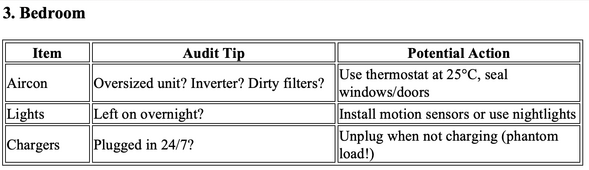
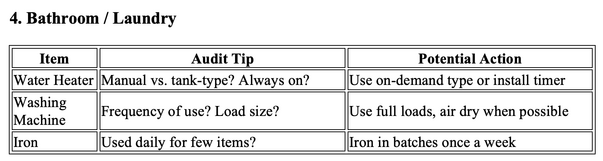
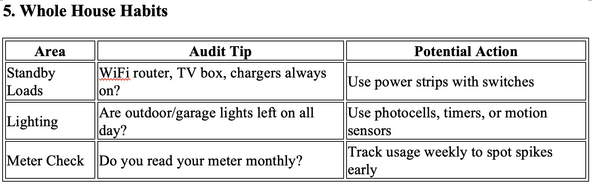
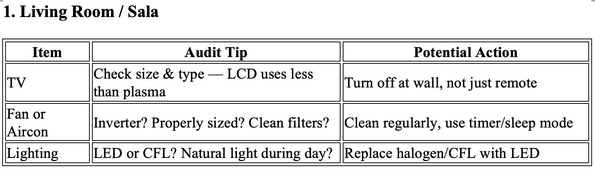
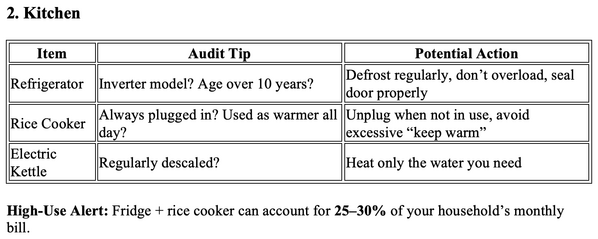
The Household Energy Audit Checklist
Use this checklist room-by-room. At the end, we’ll show you how to calculate your savings potential.
Picture
Picture
Picture
Picture
Picture
What’s Driving Your Bill?

​Most Filipino households see energy use concentrated in a few key areas:
  • Air conditioning and cooling: 30–50% of household usage
  • Refrigeration and kitchen appliances: 20–30%
  • Lighting and electronics: 10–15%
  • Standby or “phantom” loads: 5–10% (yes, even when devices are off!)

Small Fixes, Big Impact
Here are some easy wins that can shave hundreds — even thousands — of pesos off your bill every month.
Lighting
  • Replace all CFL or incandescent bulbs with LED
  • Use natural daylight whenever possible
  • Turn off lights in unoccupied rooms
 Monthly savings: ₱300–₱500

Cooling (Aircon + Electric Fans)
  • Set AC to 24–26°C — each degree lower adds ~6–8% to your bill
  • Use inverter-type models if possible
  • Clean filters monthly for better airflow
  • Use fans instead of aircon when you can
Monthly savings: ₱300–₱800 (or more)

Refrigerator
  • Don’t overload the fridge — it blocks airflow and wastes energy
  • Keep door seals tight to prevent cool air leaks
  • Defrost regularly (for non-auto defrost models)
  • Replace older, non-inverter units if budget allows
Monthly savings: ₱200–₱400

Rice Cooker, Kettle, and Small Appliances
  • Don’t keep rice cooker on “warm” for hours
  • Heat only the water you need in electric kettles
  • Batch cooking saves both time and energy
Monthly savings: ₱100–₱300

Phantom Loads (Standby Power)
Many devices continue to draw power even when not in use — including:
  • Wi-Fi routers
  • TV boxes and gaming consoles
  • Chargers left plugged in
  • Microwave displays and clocks
What to do:
  • Use a power strip with a master switch
  • Unplug devices when not in use
Monthly savings: ₱150–₱300

Laundry and Ironing
  • Run the washing machine on full loads
  • Air-dry clothes instead of using a dryer
  • Batch iron once or twice a week
Monthly savings: ₱100–₱200

Easily, your household can enjoy
​Total Monthly Savings: ₱1,000 to ₱2,500+
Annual Savings: ₱12,000 to ₱30,000+
And that’s without replacing any appliances yet. If you upgrade to inverter aircon, fridge, and washing machine, long-term savings can go even higher — especially with appliance lifespans of 10–15 years.

Quick Checklist
So here's a quick checklist to ask yourself:
  • Have I switched to all-LED lighting?
  • Is my aircon set above 24°C and cleaned regularly?
  • Are my fridge and rice cooker energy-efficient models?
  • Do I unplug chargers and appliances not in use?
  • Am I running full laundry loads and batch ironing?
If you said no to more than three, you’re likely losing ₱1,000 or more per month — without realizing it.

Audit First, Upgrade Second
Before buying expensive solar panels or new appliances, start with a home energy audit. You’ll gain:
  • Immediate savings
  • Better control over your bills
  • A clearer idea of which upgrades make the most sense
Energy efficiency isn’t just for big companies. It starts at home — with small habits, smart choices, and zero regrets.
0 Comments

Energy Efficiency: The Philippines’ First Fuel

7/28/2025

0 Comments

 
Why Using Less Energy Is Our Smartest Energy Investment

When we talk about energy transition in the Philippines, the conversation almost always turns to solar, wind, LNG, or the latest power plant proposals. But there's one powerful tool that's often left out of the picture — energy efficiency. And yet, it may be the cheapest, fastest, and cleanest source of energy we have.

In energy circles, it’s often said: “The cheapest energy is the energy you don’t use.” That’s not a slogan. It’s a strategy.

What is Energy Efficiency?

Energy efficiency (EE) means using less energy to deliver the same service — whether it’s cooling a room, lighting a street, running a motor, or operating a factory. It’s not about sacrificing comfort or productivity. It’s about upgrading systems, optimizing use, and reducing waste.

Examples include:
  • LED lighting instead of incandescent bulbs
  • Inverter-type air conditioners or chillers
  • Smart controls in buildings and factories
  • Efficient motors, drives, and process automation
  • Thermal insulation, daylighting, and passive cooling
  • Energy audits leading to retrofits or operational tweaks

Why It Matters for the Philippines

The case for energy efficiency in the Philippines is stronger than most countries. Why?
1. High Electricity Prices
At ₱10–15/kWh for many consumers, the Philippines has some of the highest retail electricity prices in ASEAN. Every avoided kilowatt-hour translates to real savings for households and businesses.
2. Grid and Supply Challenges
We regularly face tight power reserves, rotating outages, and fuel price volatility. EE reduces peak demand and defers the need for expensive new generation or grid upgrades.
3. Import Dependence
Over 50% of our energy supply comes from imported coal, oil, and gas. Using less reduces forex exposure, trade deficits, and price shocks.
4. Emissions and Climate Goals
Energy efficiency reduces greenhouse gas emissions across the board — from generation to transport to end use. It is foundational to our NDC targets under the Paris Agreement.

The Hidden Opportunity

According to the Department of Energy’s National Energy Efficiency and Conservation Plan (NEECP), the Philippines could save:
  • 24 Mtoe (million tons of oil equivalent) by 2040
  • Over ₱4 trillion in avoided energy costs
  • Avoid more than 70 million tons of CO₂ emissions
And yet, implementation remains slow. Why?
  • Limited enforcement of the Energy Efficiency and Conservation Act (RA 11285)
  • Few incentives or penalties for non-compliance
  • Low public awareness of real energy cost savings
  • Financing barriers for retrofits, especially among MSMEs
  • Absence of energy performance benchmarking in many sectors

Energy Efficiency is Infrastructure

EE is not just about light bulbs and chillers. It is national economic infrastructure that:
  • Improves competitiveness for manufacturers and exporters
  • Increases resilience to energy shocks and supply disruptions
  • Enhances energy security by stretching limited supply
  • Creates green jobs in audit, construction, and services
  • Lowers operating costs for government, hospitals, and schools

What We Need to Do

Government:
  • Fully implement and fund RA 11285
  • Require Energy Efficiency Resource Standards (EERS) for utilities
  • Launch performance-based incentives for verified energy savings
  • Make EE compliance a condition in LGU permitting and procurement
Industry:
  • Appoint and empower Certified Energy Conservation Officers (CECOs)
  • Treat energy as a cost of goods sold, not just a utility expense
  • Invest in energy management systems (EnMS)
  • Access ESPCs (energy service performance contracts) and green finance
Citizens and Communities:
  • Demand efficient appliances and better building standards
  • Monitor and reduce household energy intensity
  • Participate in load shifting and demand response programs

The First Step in Every Energy Plan

Energy efficiency isn’t an add-on. It should be the first line of action in every energy policy, climate strategy, or utility plan. It’s faster to implement than new power plants, cheaper than fossil fuels, and cleaner than anything else.
In a country where every kilowatt matters, we can’t afford to waste energy. And the good news? Efficiency is not just a technical fix. It’s an economic multiplier — and a nation-building tool.
0 Comments

    Author

    MARIA LOURDES DARIO, Principal consultant, ​specializing in Renewable Energy, WTE, PPPs, and sustainable infrastructure using climate-resilient technologies.

    Archives

    July 2025

    RSS Feed

    Categories

    All
    Circular Economy
    Energy Efficiency
    Green Hydrogen
    Renewable Energy
    Waste To Energy

Web Hosting by Hostgator